Seeking spiritual protection and solace through Quranic recitation is a well-established Sunnah in Islamic tradition. Known as Ruqyah Ash-Shar’iyyah (الرقية الشرعية) app, this practice relies on the words of the Holy Quran and authentic prophetic supplications to seek healing from spiritual and physical ailments, including the evil eye (Ayn), envy (Hasad), and spiritual harm Ruqyah Shariah app.
With numerous applications available on the Google Play Store, finding an app that combines authentic textual sources, clear audio from reputable reciters, and seamless offline functionality can be challenging. In this comprehensive Ruqyah Shariah app review, we examine the Android application Ruqyah Shariah (Ruqya 360), which centers around extended master recitations by renowned Imams—notably Sheikh Abdul Rahman Al-Sudais—alongside a curated library of Masnoon supplications.
What Is Ruqyah Ash-Shar’iyyah?
Before evaluating the application, it is essential to understand the Islamic criteria that define valid Ruqyah. Islamic scholars, citing consensus from classical authorities such as Ibn Hajar al-Asqalani, emphasize three indispensable conditions:
- Allah’s Words and Names: It must consist strictly of the speech of Allah (the Quran), His names, His attributes, or authentic prayers taught by the Prophet Muhammad (ﷺ).
- Clear, Understandable Language: Recitations must be in Arabic or clear, translated meanings free from mysterious symbols, talismans, or obscure phrasing.
- Pure Tawheed (Monotheism): Both the reciter and the listener must firmly believe that the Ruqyah has no independent power to heal; the cure (Shifa) originates solely from Allah Almighty.
The application adheres directly to these principles, organizing its library exclusively around verified Quranic passages and prophetic narrations.
Key Features of the Ruqyah Shariah App
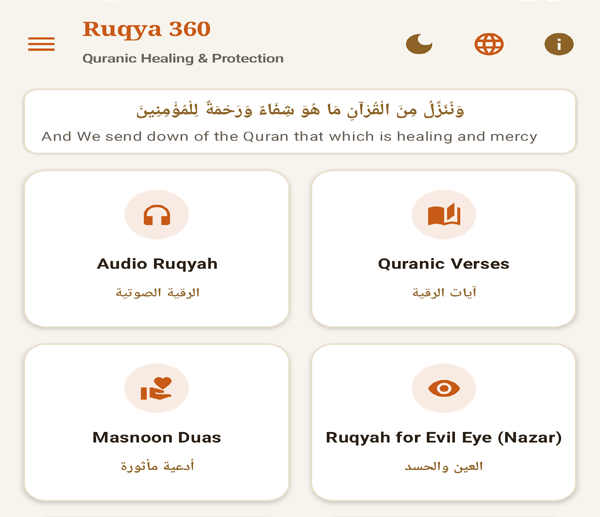
The application is designed around a practical dashboard (labeled Ruqya 360: Quranic Healing & Protection) that directs users immediately to specific spiritual needs rather than requiring manual browsing through long playlists.
1. Master Offline Audio Recitations
The standout feature of this app is its offline audio capability. Digital streaming can be disruptive during spiritual reflection, particularly if network connections drop. The app provides full-length, high-definition recitations that can be downloaded and stored locally on your device:
- Sheikh Abdul Rahman Al-Sudais: An extensive 85-minute master Ruqyah recitation covering foundational protective Surahs, including Surah Al-Fatihah, Ayat al-Kursi, the closing verses of Surah Al-Baqarah, and the Mu’awwidhat (Surah Al-Falaq and Surah An-Nas).
- Sheikh Mishary Rashid Alafasy: A 73-minute melodic recitation calibrated for physical ease and spiritual tranquility.
- Sheikh Saad Al-Ghamdi: A 61-minute recitation recognized for its calming, measured cadence.
2. Purpose-Driven Categorization
Rather than providing a single generic audio file, the app divides Quranic healing into dedicated categories:
- Ruqyah for Evil Eye (Nazar / Al-Ayn): Verses addressing envy, jealousy, and protective barriers.
- Ruqyah for Black Magic (As-Sihr): Passages dismantling occult harms according to the Sunnah.
- Ruqyah for Jinn Protection (Mass wal-Jann): Authoritative Quranic verses recited for spiritual cleansing.
- Ruqyah for Sickness & Pain (Ash-Shifa was-Sakeenah): Comforting verses aimed at promoting physical recovery and inner peace.
- Ruqyah for Home & Children (Tahseen Al-Bayt): Supplications focused on blessing living quarters and safeguarding family members.
3. Masnoon Prophetic Duas & Digital Counter
Beyond passive listening, active personal recitation is a critical pillar of spiritual healing. The app includes an authentic Masnoon Prophetic Duas section, described internally as the Authentic Prophetic Fortress (Al-Hisn Al-Haseen).
This module features an integrated digital repetition counter that helps users accurately track Sunnah-prescribed repetitions (such as repeating a prayer 3 times or 7 times during morning and evening Adhkar). Each dua card displays both the original Arabic script and its practical context—ranging from evening protection (Isti’adhah) to relief from anxieties and safety of eyesight.
Feature Overview
| Feature | App Specification | Practical Benefit |
|---|---|---|
| Audio Offline Mode | Downloadable MP3 tracks | Zero buffering; functions without Wi-Fi or mobile data. |
| Lead Reciter | Sheikh Abdul Rahman Al-Sudais | Clear, authoritative recitation from the Grand Mosque Imam. |
| Repetition Tracker | Interactive counter (3x / 7x) | Enables adherence to exact Sunnah repetition counts. |
| Interface Design | Minimalist layout with Dark Mode | Easy on the eyes during dawn (Fajr) and evening (Maghrib) prayers. |
| Categorization | 6 targeted healing pathways | Instant access to specific spiritual needs. |
User Interface & Everyday Experience
The user interface prioritizes clarity and respect for sacred texts. The typography uses clean Arabic calligraphy alongside readable English titles, making it accessible for non-Arabic speakers seeking authentic texts.
Navigation remains uncluttered: the top bar includes instant toggles for nighttime reading (Dark Mode), language switching, and comprehensive search indexing. When an audio recitation begins, a persistent mini-player appears at the bottom of the screen with basic media controls (play, pause, skip, and favorites), allowing users to browse reading cards while the audio continues in the background.
How to Use Ruqyah Shariah app Audio Effectively
To benefit most from listening to Quranic Ruqyah on your device, scholars recommend maintaining proper etiquette:
- Set Sincere Intention (Niyyah): Direct your heart toward seeking healing from Allah alone, recognizing the Quran as divine cure and mercy.
- Listen Actively: Whenever practical, listen in a quiet room with focus rather than treating the recitation merely as background noise.
- Repeat the Verses: Read along with the app’s textual sections, especially the Mu’awwidhatayn (Surah Al-Falaq and Surah An-Nas).
- Pair Audio with Personal Supplication: Combine listening sessions with the morning and evening Adhkar found within the app’s Prophetic Fortress section.
Pros and Cons
Pros
- Authentic selection strictly sourced from the Quran and verified Sunnah.
- Reliable offline functionality suitable for travel or low-connectivity environments.
- High-quality audio featuring recognized reciters like Sheikh Al-Sudais and Sheikh Alafasy.
- Thoughtful interactive counter for structured daily Azkar routines.
- Intuitive interface with quick access to dark mode.
Cons
- Contains standard ad banners (typical for free Islamic utilities, though non-intrusive during audio playback).
- Initial audio downloads require sufficient internal phone storage due to extended recitation lengths (60–85 minutes per file).
Final Verdict
The Ruqyah Shariah (Ruqya 360) Android app is a well-crafted, spiritually grounded tool for anyone wishing to incorporate authentic Quranic protection into their daily life. By combining full-length offline recitations from Sheikh Sudais with practical daily tracking tools, it bridges the gap between passive listening and personal practice.
For individuals seeking peace of mind, daily protection, or a structured guide to authentic Islamic healing, this app serves as a dependable companion on your mobile device.
Ruqyah Shariah الرقية الشرعية
استمع إلى الرقية الشرعية كاملة بدون إنترنت بصوت الشيخ السديس، مع باقة متكاملة من الأدعية النبوية للتحصين والشفاء.
GET IT ON
Google Play
Frequently Asked Questions
Does the Ruqyah Shariah app work completely offline?
Yes. While initial installation and track downloads require an internet connection, once the audio files are saved, full recitations and all text supplications work without an active Wi-Fi or mobile data connection.
Which reciters are featured in the app?
The application primarily features an extended 85-minute Ruqyah recitation by Sheikh Abdul Rahman Al-Sudais (Imam of the Grand Mosque in Makkah), alongside recitations by Sheikh Mishary Rashid Alafasy and Sheikh Saad Al-Ghamdi.
Is listening to Ruqyah on a mobile phone permissible?
Yes, listening to recorded Quranic recitations is beneficial for remembrance, learning, and creating a spiritually tranquil environment. However, scholars note that actively reciting the verses oneself and blowing over one’s hands as practiced by the Prophet (ﷺ) remains an essential complementary Sunnah.
Are the supplications in the app verified?
The supplications are organized under the Masnoon Prophetic Duas module and draw directly from established hadith compilations, focusing on well-known invocations for protection, health, and relief from hardship.